What Is the Best Commercial Roofing Material? A Louisville Contractor’s Comparison
The best commercial roofing material for most low-slope buildings is a single-ply membrane, and on most of the buildings we see in Louisville that means TPO. But “most” is doing a lot of work in that sentence. The right system depends on what happens inside the building, what sits on the roof, how long the owner plans to keep it, and how the budget looks over 20 years rather than this quarter.
HKC Roofing & Construction has been installing and replacing commercial roofs in Louisville since 2004, and TPO, EPDM, PVC, modified bitumen and metal are the systems we install. This is the comparison we would want a building owner to read before requesting bids: what each system does well, where it falls short, what the research says about how long it lasts, and the questions worth asking before anyone recommends a material.
If you want the short version, the table below covers it. The rest of the article explains why.
Commercial roofing materials compared
Cost tiers are relative to each other for a typical Louisville low-slope replacement. Dollar figures move with roof size, tear-off, insulation and access, and those are covered in a separate post on commercial roof cost. Lifespans assume the roof is inspected and maintained, which is where most of them are lost.
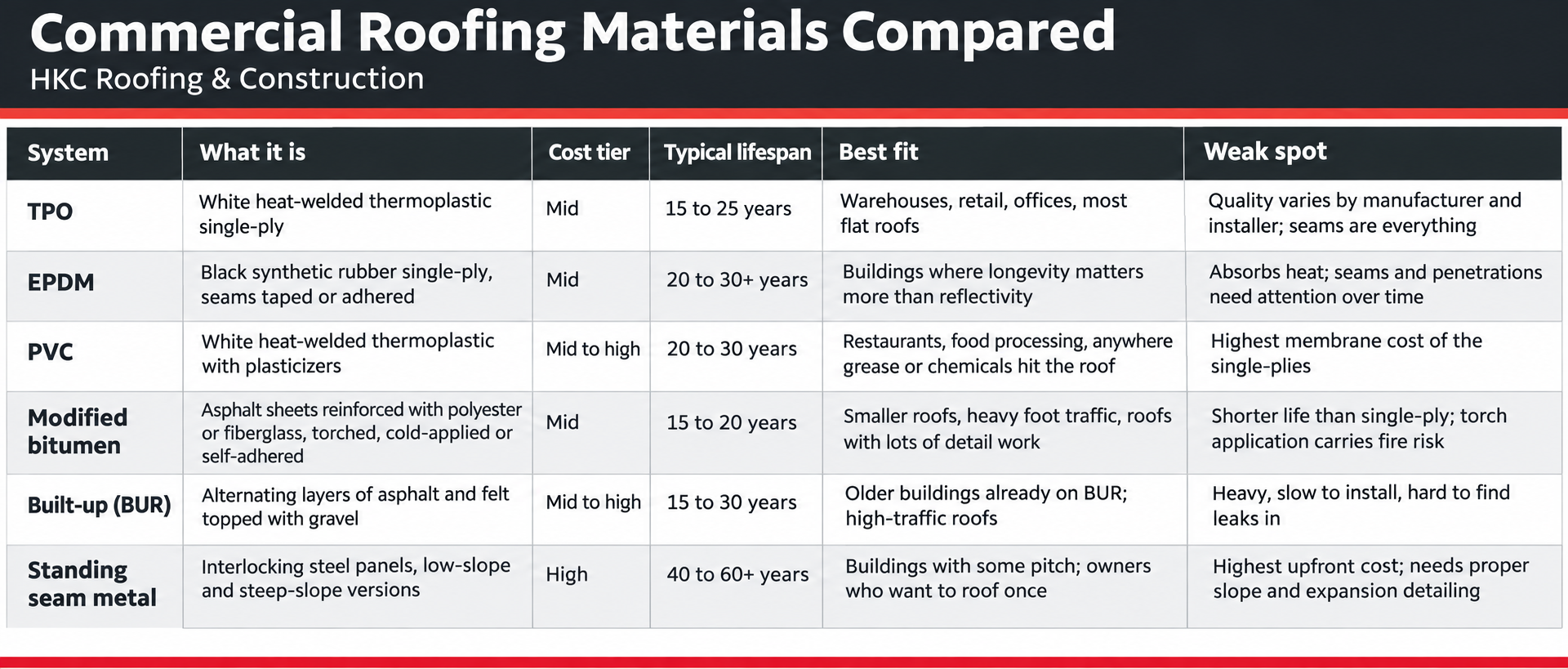
Sources for the lifespan figures that come from research rather than field experience: the EPDM Roofing Association’s service life study and the Metal Construction Association’s 60-year study, both covered below.
TPO: the default for a reason
TPO (thermoplastic polyolefin) is a white, heat-welded single-ply membrane, and it is the most installed low-slope roof in the country. In Roofing Contractor’s most recent commercial roofing survey, contractors reported that TPO makes up about half of all single-ply sales, with EPDM and PVC splitting most of the rest. That matches what is on the roofs around Louisville: if a warehouse, strip center or office building got a new flat roof in the last ten years, odds are it is TPO.
It earned that position. The seams are hot-air welded, so a properly installed TPO roof is one continuous sheet rather than a field of glued laps. The white surface reflects heat, which matters on a 100,000 square foot warehouse in July. And the material cost sits in the middle of the pack, which is why it wins most bids.
The weak spot is that “TPO” covers a wide range of quality. Formulations differ by manufacturer, thickness runs from 45 to 80 mil, and the membrane is only as good as the welds. Industry-wide, the common TPO failures are not the membrane itself. They are seams welded too cold, flashings that were never terminated correctly, and thin membrane on a roof that carries equipment traffic. Our TPO roofing page covers how we approach TPO installations and when a thicker membrane is worth the added cost.
One caveat on reflectivity. The Department of Energy’s Guide to Cool Roofs puts cooling savings at up to 15% of a single-story building’s air conditioning energy in hot climates, but it also notes a white roof can add to winter heating load. Louisville is a mixed climate. For a building that runs air conditioning heavily, white still wins. For a lightly conditioned warehouse, it is closer to a wash, and the decision should come down to the membrane, not the color.
EPDM: the one that outlasts its warranty
EPDM (ethylene propylene diene monomer) is the black rubber roof. It has been on commercial buildings since the 1960s, and it is the system most often recommended when the owner’s priority is a roof that will still be working in 25 years. The EPDM Roofing Association commissioned a field study that pulled samples from five roofs installed 28 to 32 years earlier and tested them against new-product specs. The membranes were still close to spec, and the study projected service lives approaching 40 years. The association has an interest in that result, but the finding is consistent with EPDM’s reputation in the field: when an old EPDM roof fails, it is usually the seams and flashings that give out, not the rubber.
That is the pattern to understand with EPDM. Early seams were glued, and the adhesive, not the rubber, was the weak link. Modern seam tape fixed most of that, but seams, pipe boots and curb flashings are still where EPDM roofs leak, and they need to be walked and checked on a schedule. The membrane is also black, so it runs hot in summer. On a building with heavy air conditioning that is a real cost, and it is the main reason TPO took market share from it.
Where EPDM still makes sense: owners who plan to hold the building for decades, roofs with a lot of shade or ballast, and anyone who values a 30-year track record over a 10-year one. It is also forgiving to repair, which matters when a maintenance budget is small.
PVC: when something nasty hits the roof
PVC looks like TPO from the ground. Both are white, both are heat-welded, both reflect heat. The difference is chemistry. PVC is made with plasticizers that keep it flexible, and it stands up to grease, animal fats, vegetable oil and a long list of chemicals that will eat other membranes. GAF’s building science team lays out the resistance testing and the building types it fits: restaurants, food processing, and anywhere kitchen exhaust or industrial fumes land on the roof. That is a manufacturer talking about its own product, but the chemistry is not in dispute.
If you own a restaurant, a commissary or a plant with rooftop process exhaust, PVC is usually the right call and TPO is usually the wrong one. Grease exhaust is the classic failure: a standard TPO roof rated for 20 years can break down in a fraction of that time in the area around a kitchen exhaust fan, while the rest of the roof is fine.
The trade-off is price. PVC is the most expensive of the three single-plies, and on a clean warehouse roof with nothing but HVAC units, that premium buys you very little. Spend it where it does something.
Modified bitumen: the workhorse for small and busy roofs
Modified bitumen is asphalt roofing improved with rubber (SBS) or plastic (APP) modifiers and reinforced with polyester or fiberglass. It comes in rolls and goes down in two or more plies, torched, cold-applied or self-adhered. It is the system to consider on a smaller roof with a lot of detail work, or on any roof that sees regular foot traffic from HVAC technicians and tenants, because a multi-ply asphalt roof takes abuse that would puncture a 45 mil single-ply.
The limits are real. Service life is shorter than EPDM or PVC, usually 15 to 20 years. Granulated cap sheets are dark unless a reflective one is specified. And torch-applied systems carry a fire risk during installation; cold-applied and self-adhered versions avoid the open flame and are worth specifying where the deck, the parapets or the neighboring structures make a torch a bad idea.
In Louisville, modified bitumen shows up most on older downtown buildings, mixed-use properties and additions where the roof is small, cut up and hard to access. On those jobs it is often the best value available.
Built-up roofing: still out there, rarely the answer
Built-up roofing (BUR) is the original flat roof: alternating layers of hot asphalt and reinforcing felt, usually three to five plies, finished with gravel or a cap sheet. Louisville has a lot of it on schools, older industrial buildings and anything built before the 1990s. Done right, BUR is tough and lasts a long time; the gravel surface takes foot traffic and hail better than almost anything else.
It is rarely specified for new work today, and the market reflects that. In the Roofing Contractor survey mentioned earlier, BUR was about a third of low-slope asphalt sales and shrinking, with modified bitumen taking its place. It is heavy, slow to install, needs a kettle on site, and when it leaks, finding the entry point under gravel is a project in itself.
Where BUR still matters is on buildings that already have it. If your roof is BUR and in decent shape, the right move is often a recover or a restoration rather than a tear-off, and that decision depends on a core sample and a moisture scan.
Standing seam metal: roof once
Metal is the system owners ask about when they are tired of roofing. A standing seam steel roof with a Galvalume or painted finish, installed with proper slope and expansion clips, will outlast everything else on this list. The Metal Construction Association’s service life study looked at unpainted Galvalume standing seam roofs across five U.S. climate regions, found no significant red rust on roofs up to 35 years old, and projected a service life of more than 60 years with annual maintenance. That is the life of the building.
The cost is the highest upfront of any system here, and it is not the right answer for every flat roof. Metal wants some pitch to drain; on a dead-flat deck it needs a structural redesign or a different system. It also moves with temperature, so flashings, penetrations and fastener details have to be done by someone who installs metal regularly, not occasionally. Hail is the other consideration. The May 1996 Pre-Derby storm dropped baseball-size hail across Jefferson County, and while a standing seam roof will usually keep water out after a storm like that, it will dent, and dented panels are a cosmetic and insurance conversation.
HKC installs standing seam, exposed-fastener and stone-coated metal. The buildings where metal pays off are the ones with a pitched or low-slope deck and an owner who plans to hold the property for a long time. On those, the math works. On a flat 50,000 square foot warehouse with a 10-year hold, it usually does not.
How to choose a commercial roofing system: six questions
No membrane should be picked from the parking lot. These are the questions that decide the system on a commercial roof, and they are the questions any contractor should be asking before writing a proposal.
- What happens inside the building? Kitchens, food processing and chemical exhaust push toward PVC. Conditioned office space pushes toward a white membrane. A cold-storage or lightly conditioned warehouse makes color much less important.
- What is on the roof, and how often does someone walk on it? Dozens of HVAC units, solar, or weekly service traffic mean thicker membrane, walk pads, or modified bitumen in the traffic lanes. Penetrations are where every system fails first.
- How does it drain? Ponding water shortens the life of every membrane and voids some warranties. If the deck is flat and the drains are few, tapered insulation or added drains belong in the scope, and the system choice is secondary to fixing the slope.
- How long will you own it? A 7-year hold and a 30-year hold justify different roofs. Metal and EPDM reward patience. TPO is the right answer for a lot of owners who do not have 30 years in mind.
- What is underneath? A core sample shows the deck type, how many roofs are already stacked up (code allows two), and whether the insulation is wet. That decides whether a recover is possible or a tear-off is required, and it changes the budget more than the membrane choice does. Our commercial roof replacement page walks through what that scope looks like.
- What does Louisville do to it? Freeze-thaw cycles from November through March, summer roof-surface temperatures well over 150 degrees, spring hail, and straight-line wind. Seam quality, edge metal and attachment matter more here than in a mild climate, which is one more reason the installer matters at least as much as the material.
One note about what we install. HKC works with TPO, EPDM, PVC, modified bitumen and all three metal systems covered here, so the recommendation is not steered by what is on the truck. Built-up roofing is the exception: we evaluate and replace it, but we do not install new BUR, and we would say so on a building where it was the right answer.
Not sure what is on your roof, or what should replace it?
Many building owners do not know which system is on their building, how old it is, or how many layers are up there. That is normal, and it is a 30-minute fix. HKC offers a free roof analysis for commercial buildings in Louisville and Southern Indiana: we walk the roof, pull a core if it is warranted, photograph the problem areas, and tell you which of the systems above fits your building and your timeline, in writing, with no obligation.
Call (502) 212-1081 or request a free roof analysis and we will get it on the schedule.
About the Author: Mike Kennedy
Mike Kennedy is the owner of HKC Roofing & Construction (Hilton Kennedy Company), a veteran-owned roofing and exterior contractor he founded in Louisville, Kentucky in 2004. Over more than 20 years, HKC has installed, repaired and replaced commercial roofing systems across the Louisville metro and Southern Indiana, including TPO, EPDM, PVC, modified bitumen and standing seam, exposed-fastener and stone-coated metal, along with residential roofing, siding, windows and gutters. Before starting HKC, Mike spent 12 years as Vice President of Envirotest Corp., and he holds a Bachelor of Science in Business Management from Indiana Wesleyan University. HKC is a member of the Kentucky Roofing Contractors Association, is BBB accredited, and employs Haag Certified Inspectors. Mike is active in the Lions Club of Shelby County. Reach HKC at (502) 212-1081 or through the Commercial Roofing page.